Dorothea Lange believed that the purpose of photography was not only to document an event, but to capture reality and evoke emotion in viewers. Her photography often captured people in their casual state during a historical time. These photographs tend to have a lot of detail and depth, the more a viewer analyzes what they see. Her photographs display her empathy for the subjects, and she wanted viewers to feel that empathy through simply looking at a photograph.
Robert Coles often discusses in his book, “Doing Documentary Work” that true documentary work is not only about recording true events, but it is about ethics and understanding the subject. He discusses how Lange documents history from her point of view and explains, “where we locate ourselves with respect to our vantage point as documentarians will tell us not about what (who’m) we’ll see, but who we, the viewers, are…”(Coles 42). This demonstrates that Lange’s photos show who she is behind her camera, based off of her intentions. It also tells us that viewers understand their values and empathy through looking at work such as Lange’s photography.
“The Unwritten Record” by Kaitlyn Crain Enriquez covers Lange’s most famous work and her experience as a photographer. Enriquez writes, “The War Relocation Authority hired Lange, and other photographers, to document Japanese neighborhoods, evacuation processing centers, and internment camp facilities”. This shows that Lange was officially hired by the government to document internment, although her photos went beyond simply documenting. Although she worked for the War Relocation Authority to document events, Lange used her camera to reveal the suffering and the loss of freedom of Japanese Americans.
Dorothea Lange’s photograph “Old Mr. Konda in barrack apartment, after supper” (1942) reveals her deep empathy and commitment to documenting people’s true state. In this photo, Lange captures a man sitting after dinner, with his daughter knitting behind him. Through this simple photograph, she humanizes Japanese Americans who were unjustly imprisoned, showing them as ordinary families, not enemies. The full title of the photograph notes their background as farmers, reflecting her respect to the subjects and desire to tell their full story.
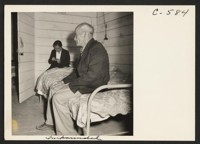
Title: Old Mr. Konda in barrack apartment, after supper. He lives here with his two sons, his married daughter and her
Leave a Reply